Home›Guides›Play-test your own card game online
Play-test your own card game online
The hard part of designing a card game is not the cards, it is finding out whether they are any good, and that takes a table and other people. Paper proxies work until your play-testers are in three cities. Untap.in is a table that does not enforce any game's rules — which is exactly what a game that does not have final rules yet needs. Upload the cards, build the decks, and play-test the thing against people who will tell you the truth.
Play-test a deck nowin your browser · nothing to install
Why a table with no rules engine is the right tool for an unfinished game
Every digital client for a published game enforces that game's rules, which means your game would have to be coded before it could be played. A shared table skips that. Cards are images with text; zones are places on the table; counters count whatever you say they count. If the rules change on Tuesday, nothing has to be re-coded on Wednesday — you play the new rule the way you would at a kitchen table. Nothing stops an illegal play, and for a game whose legality you are still deciding that is a feature.
Getting your cards in
- Pick a home for the game. Custom Card Games is the deck type for a game the database does not know: it has a play area, a deck, a hand, a discard pile and the rest, and a Card Game field so your cards are filterable as yours. 292,917 cards from other people's games already live there. If you are making custom cards for a published game, use that game's deck type instead and they sit beside the real ones.
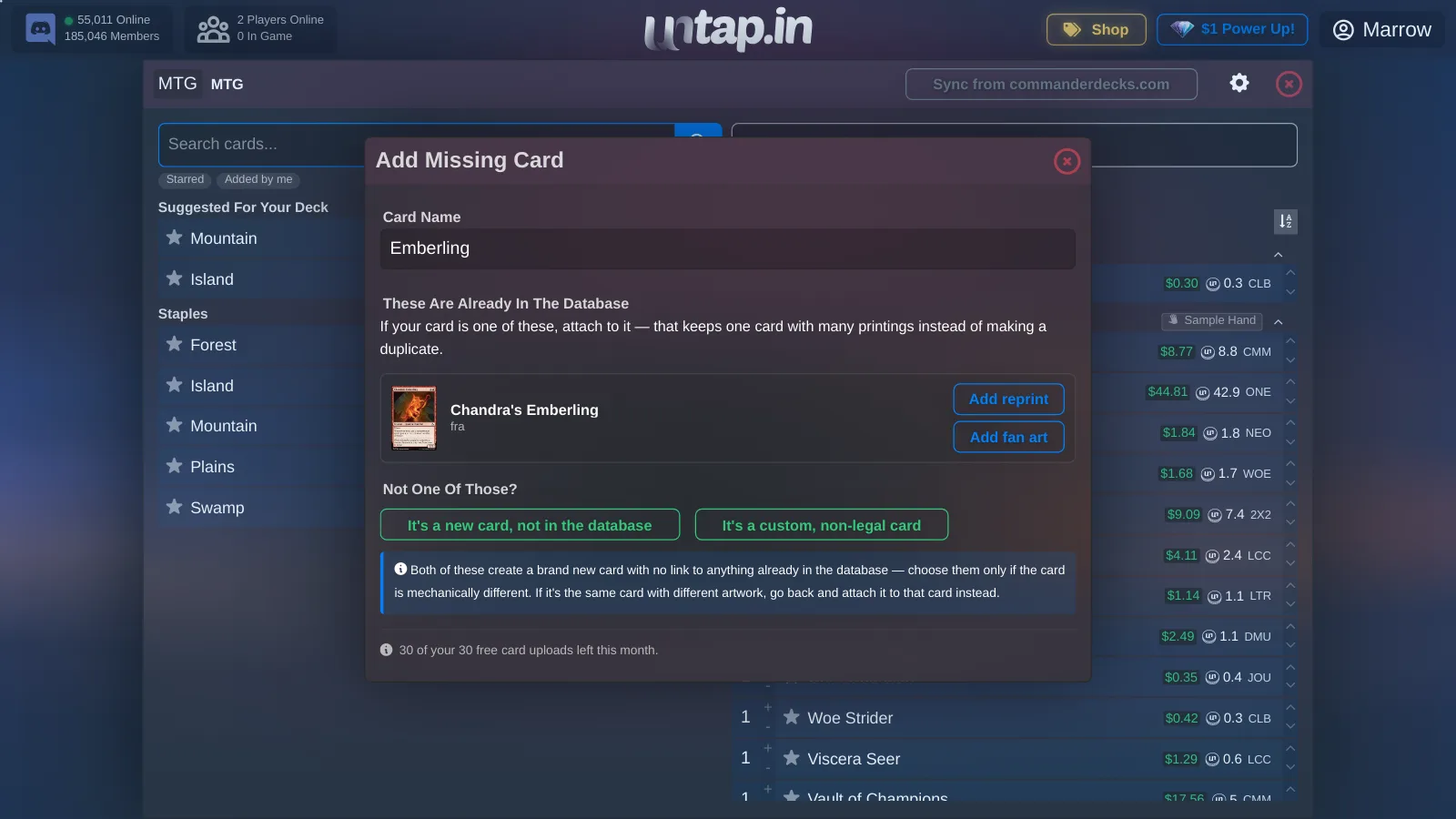
- Add Missing Card, from the deck builder. Give it a name, upload the image, and choose It's a custom, non-legal card. The name and text are read off the image where they can be, so you are not retyping every card. Thirty uploads a month are free.
- Build a deck from them like any other deck: search, drag, set the counts. Save it, and it is a deck on your account.
Goldfish it, then sit on both sides
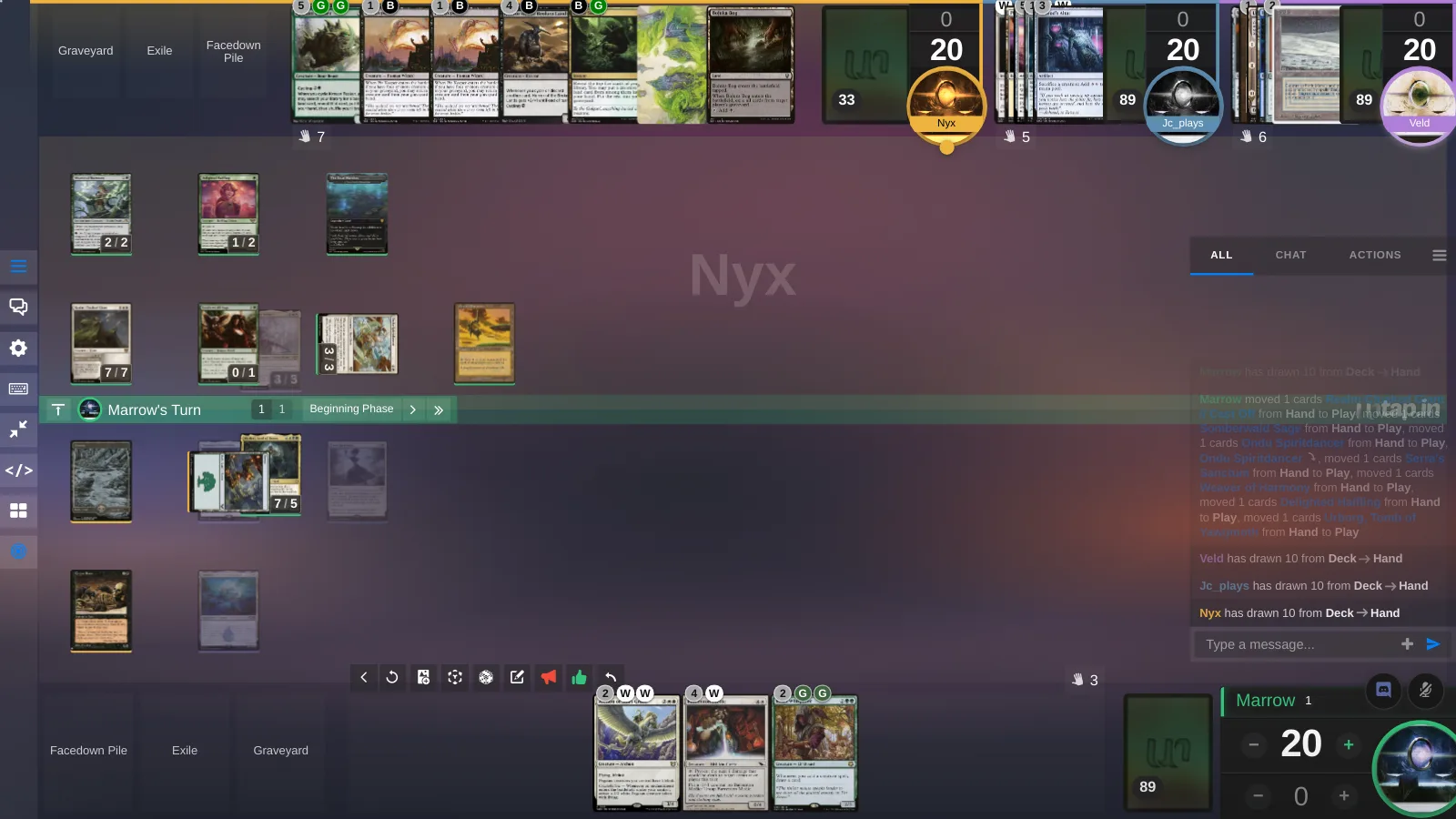
Open a Solo game to deal yourself hands and see whether the curve you drew on paper is the curve you get. Then, with a Power Up, open a Deck vs Deck game and seat two of your decks at the same table — Emberling aggro against the Stone Sentinel control list — and play both sides. For a designer this is the most useful mode on the site: you can play out a matchup twenty times in an evening with nobody else's calendar involved, and Rewind lets you take a turn back and try the other line.
Then with your play-testers
New Game → Custom Card Games → send the link. Your testers make a free account, import the deck you share with them (a deck's share link carries the cards, custom ones included), and sit down. Voice is in the table. Every game is recorded, so the play-test session is a replay you can watch back the next morning with notes, and the log says what moved where. Spectators can watch a test without taking a seat, which is how a second designer sees the game without being in it.
When the rules settle: scripts and board helpers
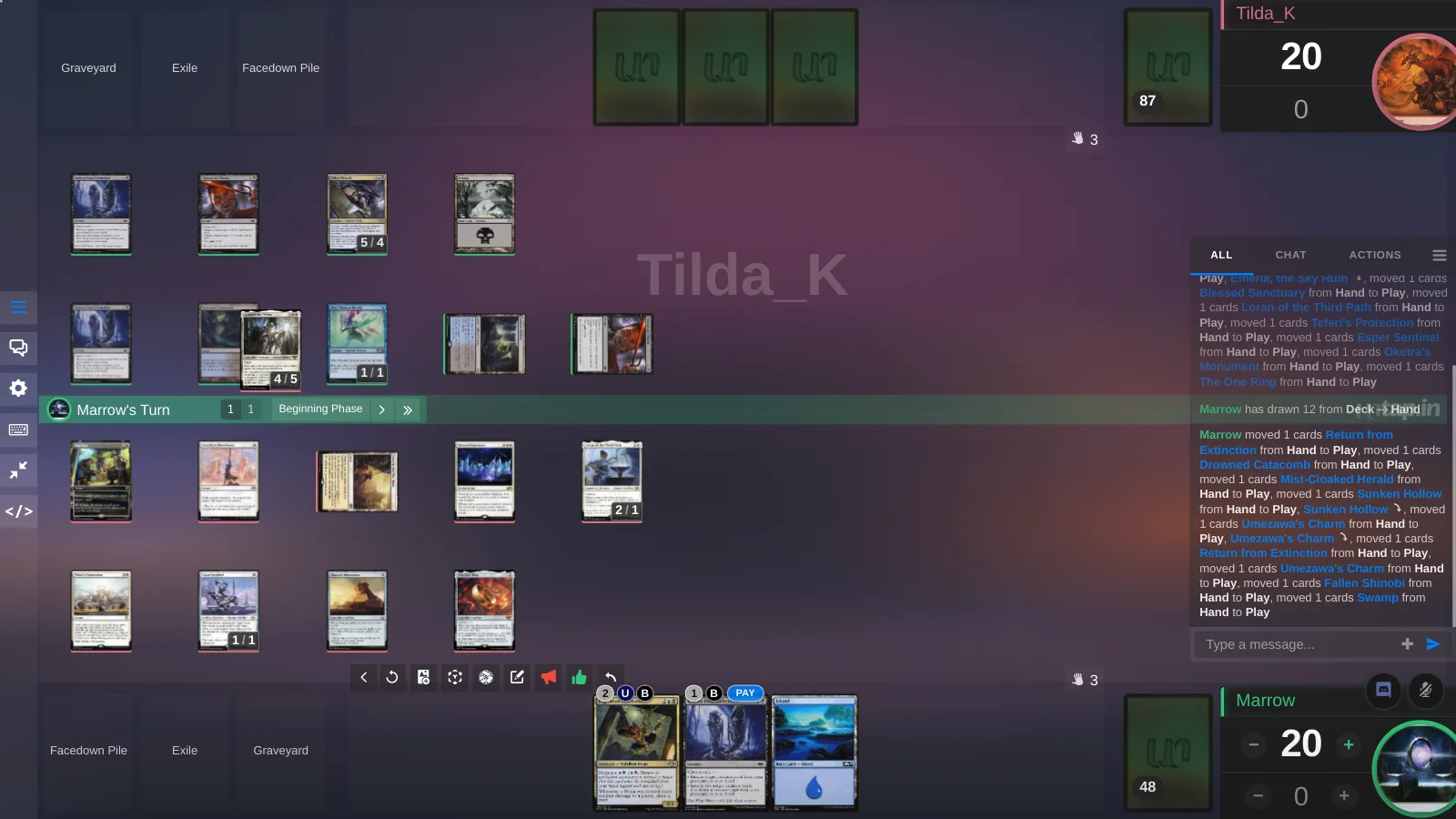
Once a mechanic is stable you can teach the table about it, without writing a rules engine. Untap Script is a small language that runs in your browser and acts through your own ordinary actions: a card script puts a button on a card that does what its text says — draw two, make a token, move a counter — and a board helper lays out furniture for the game (a box for each row, a tray for a resource, a die) and keeps counts. None of it stops a play; all of it saves clicks. The reference is written for exactly this: its examples are an invented game, so nothing in it assumes yours.
What to expect
Cards you upload are visible to other users of the site, so keep the art you own or have the right to use, and keep it within a PG rating; the form says the same before it lets you upload. A card uploaded once can be attached to again — a new printing or a new piece of art goes on the same card rather than making a duplicate, which keeps your decks pointing at one thing as the design changes. And if the game you are making is a game the database does not know but the world does, the Custom Card Games type with its Card Game field is still the right place; thousands of niche published games live there too.
Frequently asked questions
Can I play-test a card game I designed myself online?
Yes. Upload the cards with Add Missing Card into the Custom Card Games deck type, build decks, and play at a table that enforces no rules, so an unfinished ruleset is no obstacle.
Do I have to program my game?
No. The table moves cards and keeps counts; the players resolve the rules. Untap Script is there later, if you want buttons for stable mechanics, and it is optional.
How many custom cards can I upload?
Thirty a month at no cost, from the Add Missing Card form. A card that already exists takes a new printing or art without using a slot.
Can I test my game alone?
Yes. Solo for hands and curves; Deck vs Deck, a Power Up perk, to play two of your decks against each other from one seat.
Can my play-testers use my cards?
Yes. Uploaded cards are in the shared database, and a deck you share by link carries them. Your testers import it and sit down.
Can I make custom cards for a published game instead?
Yes. Add them under that game's deck type and they sit beside the official cards, searchable and playable like any other.
Is the session recorded?
Every game with two or more players is kept as a replay for thirty days, and the log records every move.
Bring a list
Import a deck, goldfish a few hands, then open a table and send your pod the link. It runs in the browser, and the first play-test takes about as long to set up as reading this did.
Play-test a deck nowMore guides
Where to play Commander online depends on what you are trying to do: goldfish a new list, play your pod across three cities, play your paper deck over webcam, or have the rules enforced. Every option, honestly compared.
Updated 11 November 2026 How to play-test a Magic deck onlineGoldfishing tells you whether a list works on its own; a real opponent tells you whether it works. How to do both online, what the deck-site playtesters can and cannot do, and how to test a change instead of guessing.
Updated 11 November 2026 MTG Arena has no Commander. Here is how to play it anywayArena's Brawl is two players at 25 life, and there is no four-player mode. Export the deck from Arena, paste it into Untap.in, and sit at a four-seat Commander table in the browser with the list you already built.
Updated 11 November 2026 Draft online, then play the deck you draftedBooster draft, cube and sealed in the browser: bots fill the empty seats, you draft from any set in the database or a CubeCobra list, and the deck you build is played at the same table. Compared honestly with the pick-trainers.
Updated 11 November 2026 Import a deck from Moxfield, Archidekt or anywhere elsePaste a deck URL from Moxfield, Archidekt, EDHREC, MTGGoldfish and dozens of other sites, or a plain-text list, and play-test it online in the browser. Every printing kept, sideboard included, nothing retyped.
Updated 11 November 2026 A Cockatrice alternative that runs in the browserCockatrice is a free desktop tabletop for Magic with no rules engine. Untap.in is the same idea with no download, voice at the table, rewind, replays and 50-odd other card games. When to switch, and when not to.
Updated 11 November 2026 An XMage alternative, for the half of you who should switchXMage enforces every rule and runs as a Java download. Untap.in trusts the table and runs in the browser. Which one you want depends on whether you are learning the rules or play-testing a deck — this page says which is which.
Updated 11 November 2026 A Tabletop Simulator alternative for card gamesTabletop Simulator is a paid 3D sandbox that becomes a card table through mods. Untap.in is a flat table built for card games, free for everyone at it, with the card database kept for you. For Magic and 50-odd other games.
Updated 11 November 2026 Pokémon TCG Pocket on a shared tablePlay-test a Pokémon TCG Pocket deck online with cards you have not pulled yet, against a friend, in the browser. Twenty-card decks, Limitless import, points on a counter, no rules engine. What the app does that a table cannot, and the other way round.
Updated 11 November 2026 Pokémon TCG online in the formats the official client will not runTCG Live runs Standard, a trimmed Expanded, and Gym Leader Challenge only in rotating windows. A shared table runs whatever your group agrees to: full Expanded, GLC any day, a 2003 deck against a 2005 deck. How, and what to expect.
Updated 11 November 2026 Play Union Arena onlineBandai has no online client for Union Arena, and TCG+ builds decks but does not play. Untap.in has the card pool and a two-seat table in the browser: import or type a fifty-card deck, send a link, and play the game the way you would across a mat.
Updated 11 November 2026 Play Final Fantasy TCG onlineA browser table for Final Fantasy TCG with every printing synced from Square Enix's official card list, deck import from FFDecks and Materia Hunter, and a real opponent. For when the Tabletop Simulator mod is four sets behind.
Updated 11 November 2026