Home›Guides›Playing dead card games online
Playing dead card games online
A card game dies the way a restaurant closes: the cards you own still work, there is just nowhere to use them. The publisher stops printing, the official site goes down a year or two later, the local scene thins out, and the rules you know are suddenly the most valuable thing about the game. None of that stops it being a good game. This is about the three things it takes to keep playing one — somewhere to play that does not need the game to be programmed, a card database that survived its publisher, and the people who, in a surprising number of cases, are still making new cards for it.
Play-test a deck nowin your browser · nothing to install
Three kinds of dead, and what each one needs
"Dead" covers three quite different situations, and knowing which one your game is in tells you what to do next.
| Where your game is | What to do about it | Why |
|---|---|---|
| Out of print, nobody is making cards | Play it on a shared table; build decks from the community archive | The game only needs players and card data now, and both still exist |
| Out of print, but volunteers still release sets | Play the fan sets — they are usually in the card database within days | Netrunner and Star Trek CCG both got new cards in 2026 |
| Licensed back into print by somebody new | Buy the new product, and use a table online between game nights | Vampire: The Eternal Struggle, Doomtown and Warlord all came back this way |
| Its cards are in no database anywhere | Upload them, once, and they are there for whoever looks next | This is the part that is genuinely lost if nobody does it |
The third row is worth dwelling on, because it keeps happening. Vampire: The Eternal Struggle ceased production in September 2010 and is now in print again under Black Chantry — a company formed in 2018 by five veteran players of the game, from five countries — which put out two new sets on 31 October 2026 and sells older singles print-on-demand. Doomtown is published under licence by Pine Box Entertainment, whose 2026 release is a re-cut base set with a new expansion on Kickstarter. Warlord: Saga of the Storm is the best story of the three: a community called the Guardians of the Storm kept it going for a decade with their own banlists, two of them founded Kingswood Games, licensed it from AEG, and shipped a new set. If your game is in that column, the useful thing you can do for it is buy the product — a table online is for the other six nights of the week.
Why a table with no rules engine outlives one that has rules
The instinct, when a game dies, is to look for a program that plays it. That is backwards, and Chaotic is the reason why. Chaotic's cards each carried a twelve-digit code you redeemed on its website to play the same cards online — the physical and digital halves were sold as one product. The servers were discontinued in 2010, the site and what was left of them went in 2013, and the client is now catalogued as lost media: not merely unsupported, unplayable. The cards in the shoebox are fine. The thing that made them work is gone, and it cannot be brought back without somebody breaking its DRM.
Anything that enforces a game's rules has to be maintained by someone who cares about that game specifically. A table that moves cards does not. Untap.in deliberately has no rules engine: zones are places, cards are images with text, counters count whatever you say they count, and the players resolve the rules between them — out of the rulebook, a scan of it, or memory. Nothing stops an illegal play. For a living game that is a trade-off; for a game whose last errata was published in 2009 it is the whole reason it is still playable, because no programmer has to have heard of your game for it to work.
The same argument applies to the parts around the table. Games are recorded as replays, so a rules argument has an appeal process. Voice is in the page, which matters more in a game with ten surviving experts than in one with ten thousand players. Tables seat 4 at no cost and up to 6 with a Power Up, which covers the multiplayer formats that 1990s CCGs were full of, and spectators can watch without taking a seat — which is how somebody learns a game nobody is teaching any more.
The other places a dead game can live
We are not the only option and for some games we are not the best one, so here is the honest version.
LackeyCCG is the traditional home of out-of-print CCGs and has been for twenty years. It is a free download for Windows, Mac and Linux, and each game is a community-made plugin carrying that game's card data and card images — which is why its plugin list reads like a museum: Babylon 5, BattleTech, Star Wars CCG, The Lord of the Rings TCG, Wheel of Time, Legend of the Five Rings and dozens more, and people were still adding to it in 2026. Like a shared table it does not enforce rules. If your game has a Lackey plugin and no card database here, Lackey is where to play it — nothing on this site helps with a game whose cards nobody has entered. What you trade for it is the install and the plugin: every player needs both, on a desktop, and the plugin's card data is as current as whoever last updated it.
A dedicated client, where one exists for your game, beats a generic table on rules. Netrunner is the clearest case: jinteki.net is a free, open-source browser implementation with the card abilities genuinely automated, and it reads its card data from the same community database we do. If you want Netrunner played correctly rather than played by hand, play it there; the reason to open a Netrunner table here instead is to run it the way you would in paper, or to have one account for a Netrunner night and a Warlord night.
Tabletop Simulator ($19.99 on Steam, often half that on sale) is the sandbox answer: anything that can be made of cards and tokens can be made in it, which covers games no database has, at the cost of a purchase per player, a download, and 3D physics between you and a card draw.
What we are for is the middle of that: a card database and deck builder per game, maintained rather than snapshotted, with a table attached and nothing to install — on a phone as well as a desktop, which matters when a scene's whole tournament runs over several weeks and somebody has to take their turn on a train.
Archiving card databases: the part that actually goes missing
You cannot build a deck for a game whose card list nobody has. This is the quiet half of keeping a game alive, and it is the half that has a deadline, because card data lives on websites and websites are rented. The official database usually goes first — it is a marketing expense for a product that no longer exists. What survives is whatever a volunteer kept.
Those volunteer databases are better than they have any right to be. wowcards.info is still the World of Warcraft TCG's card reference more than a decade after the game ended, still logging changes, and still honest about its gaps: about seventy-five card images are missing, some of them permanently, because the cards came from product nobody has a clean scan of. accio.cards does the same for a Harry Potter game that stopped printing in 2002. NetrunnerDB carries both the publisher's cards and the volunteers'. Every one of those is one person's hosting bill away from being the thing somebody has to reconstruct.
So Untap.in keeps its own copy. Each of these is a card database on the site, with its own deck builder and its own search; where a community database still publishes a feed, it is read every night and credited, and where none survived, the cards were uploaded by players one at a time.
| Game | Cards | Decks built | Where the card data comes from |
|---|---|---|---|
| Android: Netrunner | 2,062 | 505 | NetrunnerDB, read nightly — fan-published sets included |
| Warlord: Saga of the Storm | 6,369 | 8,271 | warlordccgdb.com, read nightly |
| Harry Potter TCG | 1,104 | 2,447 | accio.cards, read nightly |
| Vs System | 4,660 | 100 | ccgdb.com, read nightly |
| Star Trek CCG | 2,856 | 464 | Uploaded by players, virtual expansions included |
| Vampire: The Eternal Struggle | 3,860 | 564 | Uploaded by players; decklists import from Amaranth and VDB |
| Chaotic | 1,333 | 9,050 | Uploaded by players |
| Naruto CCG | 3,979 | 5,968 | Uploaded by players |
| World of Warcraft TCG | 8,649 | 5,398 | Uploaded by players |
| Fire Emblem Cipher | 2,591 | 1,877 | Uploaded by players |
| 7th Sea CCG | 1,780 | 1,501 | Uploaded by players |
| Bleach TCG | 240 | 1,218 | Uploaded by players |
It is worth being straight about what a hand-built catalogue looks like, because you will meet it: in games with no feed you will find the same set spelled two or three ways, promos filed under a code somebody guessed, and cards whose only image is a photograph taken on a kitchen table. That is what archiving actually looks like from the inside. It is still a deck builder that works, and anyone can fix a card they can see is wrong — a better scan attaches to the card that is already there rather than making a second copy of it, so corrections accumulate instead of forking.
We lose sources too, and recently. One of the games on this site was read from a community database that went dark overnight in November 2026; the catalogue survived intact because the cards were already here, and the feed was moved to another source the same week. That is the argument for mirroring rather than linking, and it is why none of these pages wait on somebody else's uptime.
Fan-made sets for old card games
Some communities did not stop at preserving the game. They kept designing for it, and the results are not fan-fiction — they are run like a publisher's release schedule, with playtesting, rotation and tournament legality.
Null Signal Games, a volunteer non-profit, has published Netrunner cards since the licence ended: its foundational set is 77 cards, its March 2026 set triggered a rotation in the entry-level of its tournament formats, and the next one is due in January 2027. The Continuing Committee has been releasing virtual expansions for Star Trek CCG since 2007 — two in 2026 alone, of 37 and 62 cards, one of them for the show's sixtieth anniversary. Both have been going longer than many of the games in your local shop.
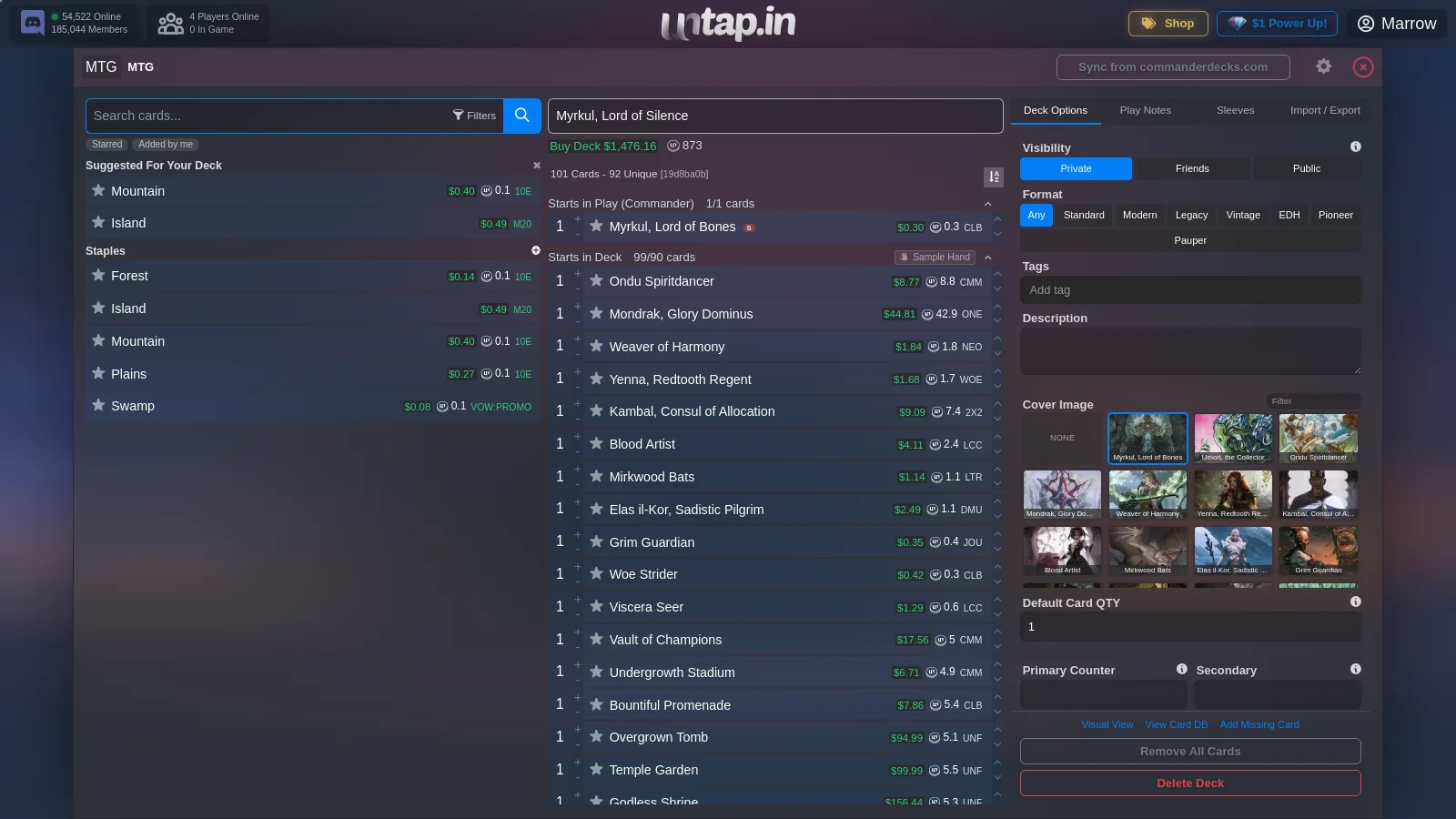
Those cards reach the site two ways. Where the community database carries them, the nightly read carries them too, so a fan set published on a Monday is usually searchable here within a day of the database listing it — Netrunner's catalogue here is one list, publisher cards and volunteer cards together, the way the people playing it treat them. Where it does not, somebody uploads them, which is the same Add Missing Card form that fills gaps in any catalogue: a name, an image, and a choice between attaching a new printing to a card that exists and adding one that does not.
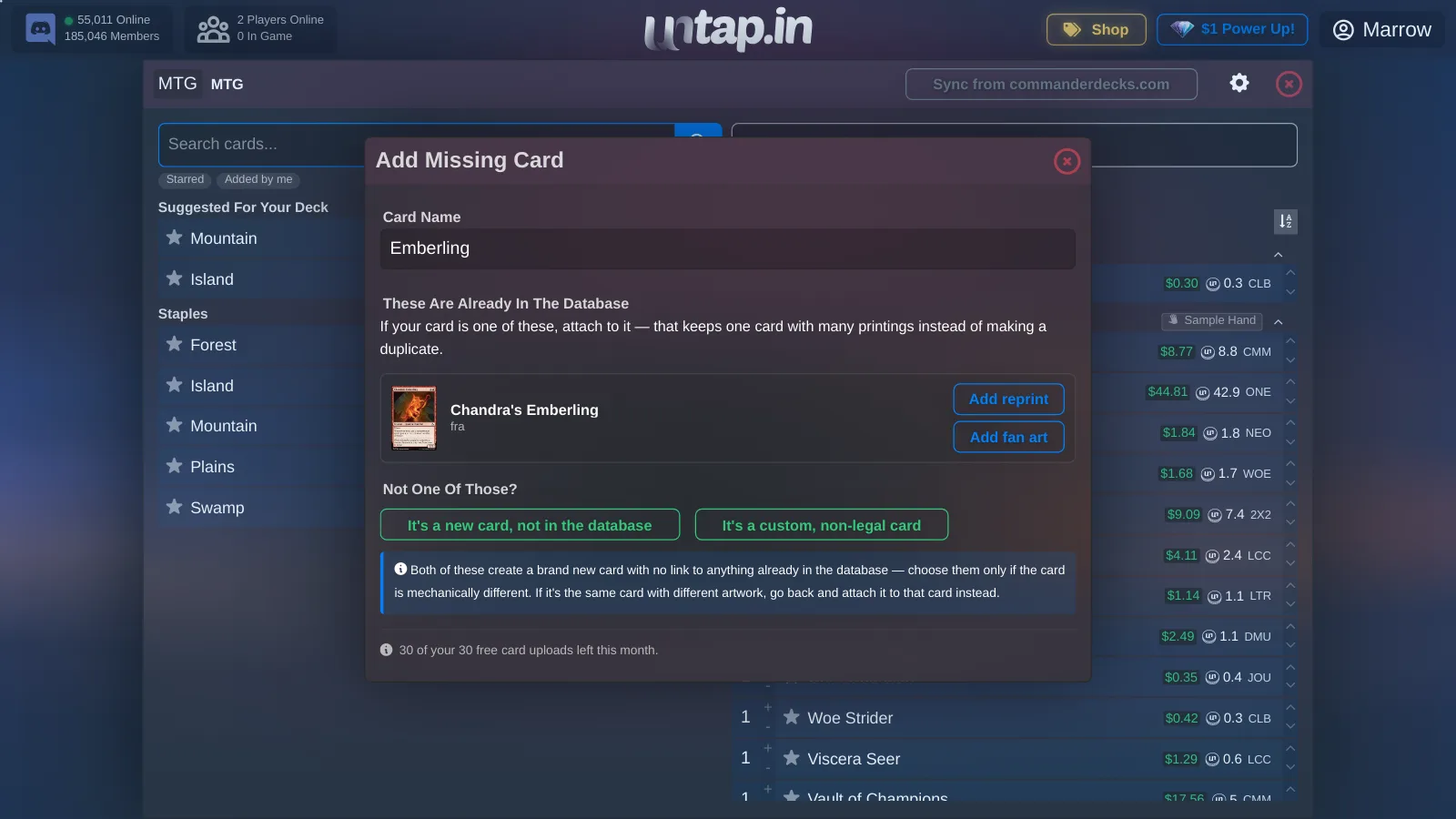
That form is also how you play cards that no publisher will ever print. Pick It's a custom, non-legal card and the card goes into that game's catalogue marked as what it is, searchable beside the official ones and filterable away by anyone who does not want it; thirty uploads a month cost nothing. Warlord's catalogue here already carries a set of exactly those — a fan set, sitting in the same search as the 1990s ones and the 2025 ones. If what you are building is a whole new game rather than a set for an old one, there is a guide for that instead.
Two things to keep in mind. Card art and text belong to whoever made them, so a fan set is on the same footing as the rest of the catalogue: upload what you have the right to upload, keep it PG, and expect the publisher's wishes to be respected if a publisher turns up again. And if your game has an official continuation in print, the fan sets are the thing to be careful with rather than the thing to lead with — that community's own rules usually say which sets are legal where, and the honest table respects them.
Finding the four other people
This is the real problem. A dead game's players are not in one city and they are not on one forum, and the game itself has no marketing left, so the community IS the game — usually a Discord of a few hundred people who all know each other.
What those groups tend to settle on is a split: chat and voice where they already talk, and play on a table in the browser, because nobody can be asked to install a client for a game with three hundred players. Warlord's online circuit writes it down on its own page — "though we do all our chatting and voice communication through Discord, we do the actual playing over a browser-based client called Untap.in" — and runs its events slowly, roughly 48 hours per round over several weeks, which is how a tournament works when the entrants are spread over every timezone. That shape travels: a league run in rounds, a Discord for scheduling, replays as the record of what happened, and no install for a newcomer to balk at.
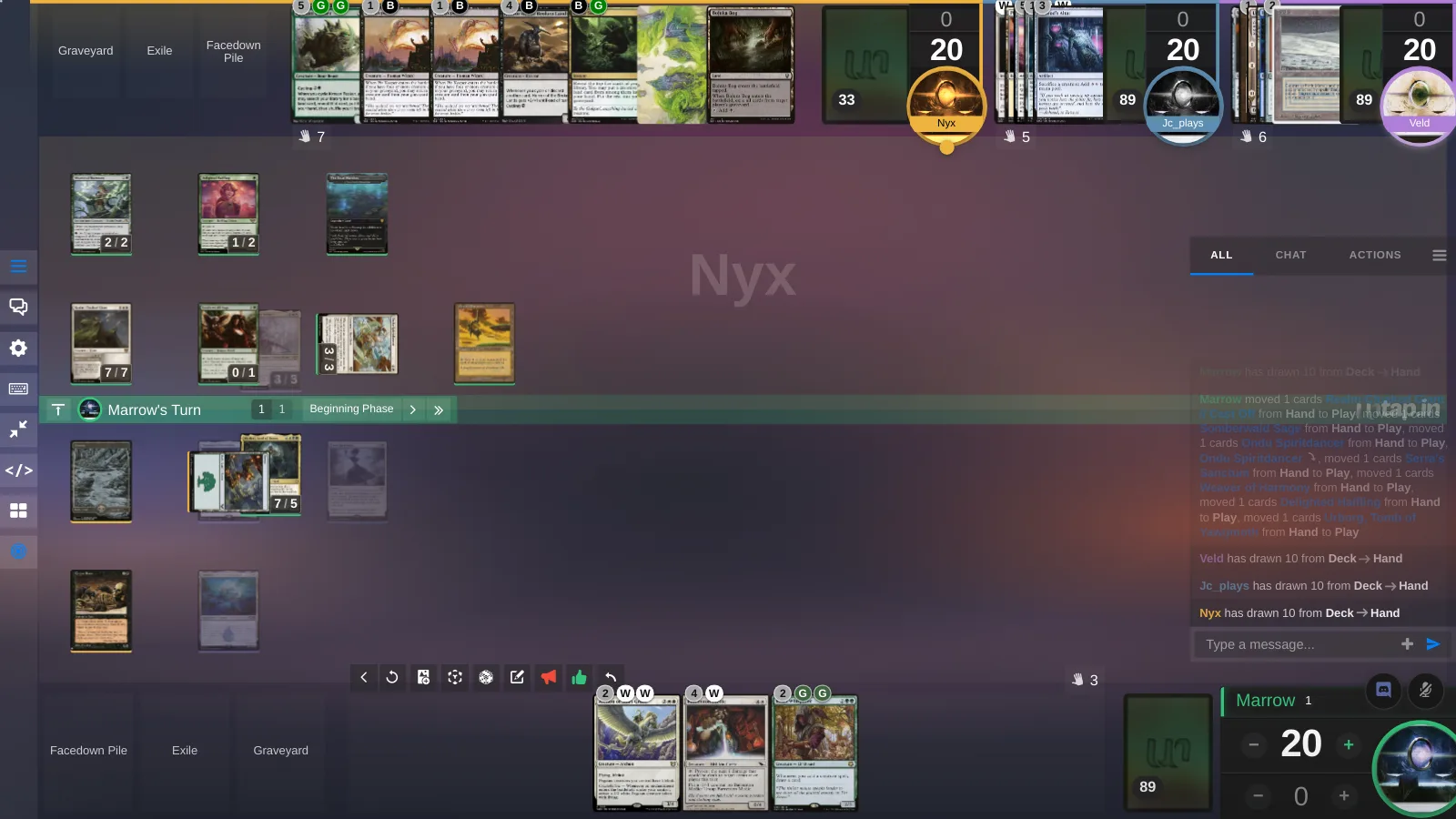
From this side there is a public lobby where an open table is visible to everyone on the site, which is a different proposition from a private Discord — a few of the games in the table above have thousands of decks built on them, and most of those people did not come from one community. The Untap.in Discord has 185,000+ members with per-game channels, and joining is signing in with Discord, which links or creates your account in the same step, so the person you find in a channel is the person who turns up at the table. If your game's community has nowhere online of its own yet, ask for a channel — it costs us nothing and it is how several of these scenes started.
Starting tonight
- Find your game. Browse the games on the site; there are 60 card databases, and a good number of them are games nobody prints any more. If it is not there, it can be — the Custom Card Games type takes a game the database has never heard of.
- Get a deck in. Paste a list, or paste a URL: where a surviving community database hosts decks, the importer reads them directly — netrunnerdb.com, amaranth.vtes.co.nz, vdb.im, warlordccgdb.com, warlorddb.com among them. Otherwise build it in the deck builder from the catalogue.
- Deal yourself a hand first. Open a Solo game to see your deck work before anyone is watching, which for a game you last played in 2011 is not a small thing.
- Open a table and send the link. New Game, pick the game, and the link goes in whatever Discord your people are in. They make a free account and sit down; nothing installs.
- Fix one card. Whatever came up wrong or missing while you played — a card with no image, a set spelled oddly, a card that was never uploaded. The next person to look for that game gets your version.
What this is not good at
Nothing enforces the rules. Somebody at the table has to know how the game works, and for a game with no active tournament scene that is a real constraint — expect to have the rulebook open. If what you want is a program that plays the game correctly, a shared table is the wrong tool — see the alternatives, one of which does exactly that for one game.
The catalogue is only as good as what survived. For games read from a live community database it is in good shape. For the others it is uneven, and the further a game is from the English-language internet the more uneven it gets — missing images, guessed set codes, a promo nobody has scanned. Those are fixable, one card at a time, by the people who care.
Playing a game online is not a substitute for supporting it. If somebody has licensed your game back into print, they are carrying real costs to do it, and the cards are the point. Play-test here, buy there.
And a table is not an archive. This site holds a copy of the card data it needs to run deck builders, which is a useful by-product rather than a preservation project; the community databases, the wikis and the people with scanners are doing the actual archiving. Back up the thing you care about yourself.
Frequently asked questions
Can I play a discontinued card game online?
Yes. A shared table that enforces no rules does not need the game to be programmed, so an out-of-print game is as playable as a current one — you and your opponent resolve the rules, the table moves the cards. Untap.in carries card databases and deck builders for a long list of games nobody prints any more, free to play-test in the browser.
What happens to a card game when its publisher stops?
The cards keep working and the official website usually does not. What survives is the community: a Discord, a volunteer card database, and in several cases a group that keeps releasing new sets. The thing most at risk is the card data, because it lives on somebody who is paying a hosting bill.
Where can I find the card list for a dead card game?
Almost always a fan-run database — wowcards.info for the World of Warcraft TCG, accio.cards for the Harry Potter TCG, NetrunnerDB for Netrunner. Untap.in keeps its own copy of the catalogues it runs deck builders for, reading the surviving databases nightly where one publishes a feed and crediting it.
Are people still making new cards for old card games?
Yes, and seriously. Null Signal Games has published Netrunner sets since the licence lapsed, with a 2026 release and another due in January 2027; The Continuing Committee released two Star Trek CCG expansions in 2026, of 37 and 62 cards. Both run playtesting and tournament legality the way a publisher would.
Can I add fan-made sets or custom cards to a dead game?
Yes. Add Missing Card puts a card into that game's catalogue — attached to an existing card as a new printing, or as a new card marked custom and non-legal so anyone can filter it out. Thirty uploads a month at no cost. Upload only art and text you have the right to use.
Is LackeyCCG or Untap.in better for old card games?
Whichever one has your game. LackeyCCG's community plugins cover 1990s CCGs nothing else carries, and it is free, but every player installs it on a desktop and the card data is as current as the plugin. Untap.in needs no install, runs on a phone, and keeps its card databases maintained nightly where a community feed survives — but only for the games it has. Neither enforces rules; where a dedicated client exists for your game, such as jinteki.net for Netrunner, that beats both on rules.
Do I need to install anything, or own the cards?
Neither. It runs in the browser on a phone or a desktop, accounts are free, and a deck is a list — which is the only way some of these games are playable at all, since the cards are twenty years out of print and priced accordingly.
How do I find other players for a game this old?
Through the game's own community first — most dead games have a Discord, and that is where the scheduling happens. Untap.in's public lobby lists open tables to everyone on the site, and its Discord has per-game channels; several out-of-print games have thousands of decks built here, so the players exist.
Why not use the old official online client instead?
Usually because it is gone. Chaotic sold cards with codes that unlocked its online game; the servers were switched off in 2010, the rest followed in 2013, and the client is now catalogued as lost media — unplayable, not just unsupported. Anything that needs a company's servers dies with the company's interest.
Bring a list
Import a deck, goldfish a few hands, then open a table and send your pod the link. It runs in the browser, and the first play-test takes about as long to set up as reading this did.
Play-test a deck nowMore guides
Where to play Commander online depends on what you are trying to do: goldfish a new list, play your pod across three cities, play your paper deck over webcam, or have the rules enforced. Every option, honestly compared.
Updated 15 November 2026 How to play-test a Magic deck onlineGoldfishing tells you whether a list works on its own; a real opponent tells you whether it works. How to do both online, what the deck-site playtesters can and cannot do, and how to test a change instead of guessing.
Updated 15 November 2026 MTG Arena has no Commander. Here is how to play it anywayArena's Brawl is two players at 25 life, and there is no four-player mode. Export the deck from Arena, paste it into Untap.in, and sit at a four-seat Commander table in the browser with the list you already built.
Updated 15 November 2026 Draft online, then play the deck you draftedBooster draft, cube and sealed in the browser: bots fill the empty seats, you draft from any set in the database or a CubeCobra list, and the deck you build is played at the same table. Compared honestly with the pick-trainers.
Updated 15 November 2026 Import a deck from Moxfield, Archidekt or anywhere elsePaste a deck URL from Moxfield, Archidekt, EDHREC, MTGGoldfish and dozens of other sites, or a plain-text list, and play-test it online in the browser. Every printing kept, sideboard included, nothing retyped.
Updated 17 November 2026 A Cockatrice alternative that runs in the browserCockatrice is a free desktop tabletop for Magic with no rules engine. Untap.in is the same idea with no download, voice at the table, rewind, replays and 50-odd other card games. When to switch, and when not to.
Updated 15 November 2026 An XMage alternative, for the half of you who should switchXMage enforces every rule and runs as a Java download. Untap.in trusts the table and runs in the browser. Which one you want depends on whether you are learning the rules or play-testing a deck — this page says which is which.
Updated 15 November 2026 A Tabletop Simulator alternative for card gamesTabletop Simulator is a paid 3D sandbox that becomes a card table through mods. Untap.in is a flat table built for card games, free for everyone at it, with the card database kept for you. For Magic and 50-odd other games.
Updated 15 November 2026 Play-test your own card game onlineDesigning a card game, or custom cards for one? Upload the cards with their art and text, build decks from them, goldfish alone or sit on both sides, then play-test against real people in the browser. No rules engine to code against.
Updated 11 November 2026 Pokémon TCG Pocket on a shared tablePlay-test a Pokémon TCG Pocket deck online with cards you have not pulled yet, against a friend, in the browser. Twenty-card decks, Limitless import, points on a counter, no rules engine. What the app does that a table cannot, and the other way round.
Updated 11 November 2026 Pokémon TCG online in the formats the official client will not runTCG Live runs Standard, a trimmed Expanded, and Gym Leader Challenge only in rotating windows. A shared table runs whatever your group agrees to: full Expanded, GLC any day, a 2003 deck against a 2005 deck. How, and what to expect.
Updated 11 November 2026 Play Union Arena onlineBandai has no online client for Union Arena, and TCG+ builds decks but does not play. Untap.in has the card pool and a two-seat table in the browser: import or type a fifty-card deck, send a link, and play the game the way you would across a mat.
Updated 11 November 2026 Play Final Fantasy TCG onlineA browser table for Final Fantasy TCG with every printing synced from Square Enix's official card list, deck import from FFDecks and Materia Hunter, and a real opponent. For when the Tabletop Simulator mod is four sets behind.
Updated 11 November 2026